Sunday, 9 February 2014

Sumo

Things I thought I knew about sumo wrestling before I watched it:

It consists of fat Japanese men wrestling in nappies.

Things I found out from going to a sumo tournament:

Fat's not the word. Even the biggest sumo wrestlers (rikishi) live on a healthy-ish diet of 'chankonabe', or meat and vegetable stew. They just eat a lot of it. The result is that under their layer of fat rikishi are enormously muscular, which makes them surprisingly graceful - at least inside the ring. Judge for yourself, from the photos I took at the tournament:


The men aren't actually all that big. Some are pretty small. There are no weight divisions in sumo, which means that a small wrestler can sometimes find himself up against someone twice his weight. Eep. 

Rikishi aren't always Japanese. Japan may be the only country where it's an official sport, but wrestlers of various nationalities compete.

It isn't just men pushing each other around in a ring: both the sport and the wrestlers' lives are highly regulated. Each little detail, from the wrestlers' hairstyles to the slippers that they wear, is chosen for them and steeped in tradition and ritual. Rikishi live together in 'stables' and on the rare occasions that they appear in public must wear full traditional dress of cotton yukata and wooden slippers (geta). Geta make a loud 'clip-clop' noise on the ground, and so one of the rewards of moving up the sumo ranks is that straw slippers can be worn and the wrestler can avoid sounding like a horse.


The outfit that wrestlers wear in the ring? Not (surprise surprise) a nappy, but a silk belt or 'mawashi'. Nowadays if a rikishi's mawashi completely unravels in a bout he is immediately disqualified - a rather ignominious end to the match. However, this is apparently due more to western awkwardness about nudity than Japanese tradition. In fact Japan is pretty OK with nudity, doubtless a result of the onsen culture.


Friday, 7 February 2014

Hanegi Park


Ode to a kotatsu

Japanese houses are rarely insulated and retain almost no heat. So despite the swanky-sounding name, a Japanese 'manshon' is, in winter, pretty much a glorified refrigerator. Ours is currently covered (windows and doors at least) in many layers of bubble wrap - the hyaku en (60p) per roll answer to double glazing which is effective but does get a few funny looks from the post/ pizza man. 

So this week we got a kotatsu, in a bid to keep warm through the storms and snow that will apparently arrive tomorrow. This is a kotatsu (not ours) on traditional tatami flooring:


The best bit about kotatsus, and what's not clear from the picture, is that inside the table there is an electric heating element. So a kotatsu is a heated table with removable blankets both in the middle and underneath, which has apparently - thank you wiki - been around in Japan in one form or another since the 14th century. The idea is to sit around on floor cushions (zabuten) with your legs under the blanket, and keep warm without wasting money heating your whole apartment/ house, whilst still being able to do things like work, eat, watch films etc, thanks to the table-top. 

This is the current state of ours:


The book on the right is Peter Rabbit, or ピーターラビット (Piitaa Rabitto), as having finished A Very Hungry Caterpillar I have decided to make the leap from 3- (??) to 6-year-old Japanese child. Either that or I'll transform into a cat, having now started to take naps under the kotatsu in typical Japanese cat-style.

Thursday, 23 January 2014

Raw horse

Tonight I ate horse sashimi. I.e. a slice of raw horse. It didn't taste like chicken. 

Friday, 17 January 2014

Little Tokyo

Not long before moving to Tokyo I watched Lost in Translation. I wondered whether it was a good idea for me, then pretty nervous about the move, to watch a film about feeling alienated in my soon-to-be home, and whether soon it would be me sitting in a hotel room feeling isolated in the huge city.

*

I arrived in September, speaking little to no Japanese; just enough to say 'good morning', 'good evening', and 'thank you.' (I recently found the notes I made in my first Japanese lesson - a hesitant and misspelled collection of nouns, with nothing yet to connect them):


Despite this people were friendly and patient, even when I must have sounded quite rude. I approached strangers and said, in what I then thought was polite Japanese, things like: 'Eki wa doko desu ka?' Later I found out that this is pretty blunt, along the lines of: 'TELL ME WHERE THE STATION IS', and that much better would be: 'Sumimasen, watashi wa eki e ikitai desu ga...' - 'Excuse me, I'd like to go to the station but...', leaving them to fill in the directions part.

Nothing has made me feel more at home than the convenience store (conbini) where I live. It is so close to the flat that it has sort of become an extension to our living room, where we pop down in slippers if we fancy an ice cream or ball of fried octopus.

There is an oldish man who works there. Once I went in with a big camera around my neck and he pointed, chuckling: 'Cam-e-ra man?' It was the first time he had said anything other than the usual welcomes, thank yous, etc, and so I let the dubious implications for my appearance slide. Before Christmas he appeared with two satsumas: a present. He'd realised that I live with the other gaijin who I sometimes shop with, and so gave one for me and one for Jim, too. Shortly after Christmas I asked whether they had any apples, and was told, literally, 'it is not excusable but we do not have apples.' Today, two weeks later, he came up to me and said, almost conspiratorially, 'ringo', pointing at some apples. I was more happy that he remembered than about the apples, and somehow emitted a high-pitched 'ooh', which he imitated before walking away laughing.

This is just one of many unnecessary, kind things that people have done since I've been here, which have no doubt helped to stave off the culture-shock and isolation promised in some films and forums. Our wonderful koto teacher, when I mentioned that I liked sweet things, the following week gave us this:


The waitress at a local cafe remembers that I like coffee with whipped cream, and helps with my homework; back in September our estate agent spotted a group of us having lunch and used a considerable amount of his own break to come into the restaurant and translate its menu for us.

*

I can definitely recognize *some* aspects of Lost in Translation in Tokyo. Happily these aren't isolation and alienation, but kareoke bars, and cringy adverts featuring aging western celebrities. Here's Ringo Starr promoting apple juice:


Sunday, 12 January 2014

Used knicker vending machines...

... Do not exist in Japan, I'm convinced. In fact the 'weirdest' vending machine I've seen during 4 months living here is this one stocking batteries, which I saw this weekend in Nikko. 


Crazy. 

Thursday, 9 January 2014

Nanji?!


I'm a little too proud at the title of this post. (Immersed once more in language school, otherwise dreadful jokes take on a strange hilarity as we're still unable to articulate anything genuinely witty...) Nan (なん) is the Japanese for 'what?' and combined with the 'ji' of kanji, it describes my confusion at some of our teachers' explanations.

Some kanji make perfect sense, and these are always easiest to remember. 

Student (gakusei) is a combination of 学 (gaku) meaning study, and 生 (sei), meaning born: 学生 - gakusei, born for study. Teacher (sensei) uses the same 'sei' kanji - 生 - but prefixes it with 先 (sen), meaning before or previously. So a student is born for study, and the teacher is previously born, or older. 

One that I haven't quite got my head around yet is the kanji for home: 家 (ie). 


The bit at the top is a roof. This makes sense. The bit underneath? This depicts, apparently, a pig. Home? A pig underneath a roof. Or, a thing that as far I can see bears no resemblance to a pig, but is nonetheless a pig, underneath a roof. It wouldn't have been my first description of home (even in the medieval period, when these kanji were adopted) but maybe I'm strange. 

But then I'm not sure how closely Naganuma sticks to original etymologies. Other contenders for most tenuous kanji explanation include: 


Old man crouching on a child next to another old man holding a bag...? Of course - to teach! This would definitely not be allowed in schools nowadays, at least.

I'm guessing that this isn't the centuries-old root of the word soto (outside) either:


Man with a cigarette about to be crushed by a giant cigarette.


Monday, 30 December 2013

Forgetting French

Some months ago I met a Japanese woman who, I had heard, spoke French. Being then a total beginner to Japanese, after a few sentences in Japanese I asked if we could speak in French. Her answer? 'Le francais, j'ai oublié.' It turned out that she had forgotten. The whole of French.

Three months later - this Christmas - I went to Switzerland and found myself trying to speak French.

Ordering drinks I struggled to remember basic words, even 'please' and 'excuse me', as the Japanese popped into my head more quickly. People asked me questions and I replied, unhesitatingly, with a stream of 'はい, はい, はい'. The word はい (yes) sounds the same as the English 'hi', so my stream of Japanese
perhaps made me seem like some crazy Brit with an extreme need for acknowledgement, something like
this:

French waitor: Bonjour
Me: Bonjour
FW: Would you like something to drink?
Me: はい. Coke, please.
FW: Yes, hi... Something to eat?
Me: はい, s'il vous plait.
FW: ... Is that all?
Me: はい.
FW: ...

Sentences like 'un coca, おねがいします' sometimes fell, panicked, out of my mouth. 

I wasn't really speaking French or Japanese, but some conflation of what I was most used to saying in 
both; basically 'Foreignese'.

It seems that there's only enough room for one studied language in my brain, and Japanese is steadily pushing 
out French as sole occupant. Most likely Harry Hill has crept into my head somehow, inviting French in one
corner and Japanese in the other to: 'FIGHT!'


I don't mind. In fact I'm pretty happy at this development. In September, starting out in Japanese, to say anything
at all was a struggle. I wished I had the seven years' learning behind me that I already had in French. I've learned
two things: 

(1) Immersion works. From day one, my language school spoke to me solely in Japanese. In three months
I have learned not quite, but close, to the amount I learned in seven years of French lessons.

(2) Escaping immersion pays, too. It was impossible to see that I'd progressed from within Japan, because
I was constantly using Japanese, and being made aware of how much I *didn't* know. Being in Switzerland and realising
that most of the things I could say in French I could say in Japanese, and more naturally at that, made me proud 
of my Japanese.

Monday, 2 December 2013

To desu or not to desu

My mind has recently been blown (see Fig.1) by the information that です (desu), as used in sentences like:

わたし は Charlotte です
(Watashi wa Charlotte desu)
I am Charlotte 

Or 

そら は あおい です
(Sora wa aoi desu)
The sky is blue

Is not an equivalent of the English verb 'is', and is not actually a verb at all. 

Fig.1


The 'desu' in a Japanese sentence is not a verb but, rather, just a politeness marker. In case the sentence 'the sky is blue' sounded a little rude the first time. In the sentence sora wa aoi desu (the sky is blue) the desu isn't actually needed, unless you're trying to be polite: remarking to your boss that the sky is blue, for instance (and probably receiving a withering look for wasting time..) 

The は (wa) is not a verb, either. It is a particle, marking out the sentence's topic: the sky. 

So the sentence translates literally as: 'as for the sky, blue'. No verb.

This leads me to my second recent realisation about the Japanese language... 

Often in Japanese, words that in English we would call adjectives behave like verbs. Yes, あおい (blue) despite being called an adjective, actually acts like a verb. The result? Here in Japan, the sky blues. My bag reds. Mountains big and a mouse smalls. 

This has had little impact on my actual learning of the language so far, except perhaps a slight suspicion when my teachers insist that desu must be used in every 'otherwise' verb-less sentence. I and hundreds of others are being trained to speak such polite Japanese that, apparently, we are actually identifiable on opening our mouths, by some members of the public:

 'How polite, you  don't happen to go to 東京日本語学校...?'

Wednesday, 27 November 2013

Man-ji

I can't help but feel that women get a raw deal, kanji-wise: 


Yes, man is muscle-clad rice-provider; woman Blobbyesque Martian. Obviously. 

Monday, 25 November 2013

Atatakakunakatta: or why I'm glad it's turned cold

The one consolation of the now wintery weather is that I can escape using the Japanese word for warm: あたたかい (atatakai).

Hiragana is one of three Japanese alphabets. It is used to form words which (1) have entered the language since the adoption of Chinese kanji in the 7th century, and (2) are not foreign imports (these being formed from the 3rd alphabet: katakana). Transcribed into Roman alphabet (Romaji), hiragana characters almost invariably comprise two letters, the second of which is a vowel. For instance ひ is transcribed as 'hi' (the i pronounced as in 'if'), ら pronounced 'ra', が read as 'ga', and な as 'na'. Together these create ひらがな, or hiragana. 

The two-letter pairings and final vowel sound in most hiragana characters often make Japanese sound a little staccato, which brings me back to the word for warm: atatakai. Hard enough to get right in its simplest form (above), pronouncing it it the negative and past is sort of like trying to pronounce supercalifragilisticexpialidotious when you first watch Mary Poppins: the harder you try to say it the further away you get, until you give up, laughing and somehow floating near the ceiling. 

My teachers ask about the weather a lot, and so I try to tell them that it is:

あたたかい - atatakai - warm

あたたかくない - atataka kunai - not warm

Or, was:

あたたかかった  - atataka katta - warm

あたたかくなかった - atatakaku nakatta - not warm. 

Yesterday I correctly pronounced atatakaku nakatta for the first time. I'm still quite glad that now, when the teacher asks me what the weather is like, I can say, consistently: さむいです - samui desu - it is cold. 

Saturday, 16 November 2013

For Amy

I may have been slow at emails, but I have been taking some pictures to answer your question about food here! So here's a tiny snapshot... 

Last week our koto (traditional Japanese harp - I'm finally learning an instrument!!) teacher gave us a bag of potatoes from Hokkaido, the northernmost island of Japan, with the instructions: たべてください - tabete kudasai, or 'please eat.' It was an unexpected but lovely present, and lacking an oven we made these: 


Or, 'Hokkaido butties'. Yum. 

Yesterday we visited Hakone, a mountainous region west of Tokyo where you can see monkeys (apparently) and Mt Fuji and a 'coffee and sausage restaurant.' Lunch was not coffee and sausages, but a set of vegetables, rice, pickles, and miso soup: 


The little purple thing on a leaf is pudding, sweet red beans in powdered rice starch - surprisingly delicious! 

Most things here that sound horrible actually aren't; for instance BBQ tea, chicken womb, this: 


One thing sounds disgusting and is: natto, or sticky, slimy, fermented soy beans.

There is less sushi than I imagined, and sometimes we hunt for sushi and end up lost, confused, and eating Vietnamese food. But you can get really good sushi from the supermarket - this was 3 quid: 


Properly settled in, we plan to cook more now, and today bought, amongst other things, katsuobushi (smoked dried fish shavings used to make soup etc) and Kyoto red carrots.


Here is a superhero made out of toast, to end this rambly response to your question!

Monday, 11 November 2013

Christmas is all around, Tokyo

Naively I thought that I might escape the ever elongating Christmas lead-up here in Japan. I expected that Christmas would be celebrated by a country which lays on festivities for Halloween, Valentines, St Patrick's day and everything in between, but was not prepared for the suddenness with which Christmas descended. In typical Japanese fashion the season has arrived, every bit as merry as in the UK, but far more organized.

On October 31st Shibuya was awash with orange and black; shops, restaurants and kareoke bars filled with all manner of witches, vampires, and, for some reason, pokemon characters. On November 1st the theme became decidedly more glitzy. For instance, this happened: 


And (not that Starbucks is the best barometer of Japanese culture, but is ubiquitous here, and very popular among natives and gaijin alike) this: 

Sitting in Starbucks - the peddler of my new addiction, Matcha Frappuccino - on November 1st, I practiced my kanji to a playlist of Jingle Bells and Wonderful Christmastime, and smiled at the sheer ridiculousness of being told to have myself a merry little Christmas on the first of November, in the still humid weather.

So Christmas fever is here in Tokyo, characteristically punctual. The actual day is quite different from Christmas in the UK, though. Friends tell me that in Japan Christmas is decidedly not a family affair. The usual thing to do on Christmas (celebrated on the 24th, and as such more in line with Scandinavia than the UK) is to go out with friends or partners to an izakaya (bar) and get wasted in a good old 'nomihodae', or all you can drink. かんぱい! 

You wouldn't do this so much on New Years though - New Years here is a time to go out for a meal with your family. Oh, and hear Auld Lang Syne piped, on repeat, in department stores (though apparently that happens at other times of the year, too).

My favourite image of Christmas in Japan us one that Jim told me:

In Osaka a few years ago local authorities, decorating for Christmas, understood the festival's twin Christian (the nativity, Jesus, etc) and commercial (presents, Father Christmas) significance in the west, but not quite how these two worked together. Their municipal decoration? Father Christmas, being crucified. 

Friday, 8 November 2013

Children's literature

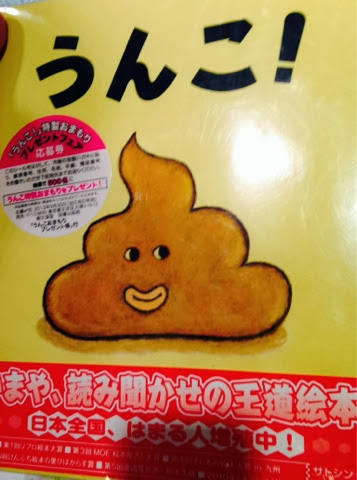
I found these in the children's fiction section of Tsutaya in Shibuya, shelved somewhere between Winnie the Pooh and the Moomins. It's a small section, just four or five shelves, and so each book is presumably chosen with some care. This begs the question: are these normal children's books, or am I ultra prudish?

Literally, the title of this book in English is 'Shit!' Or so says Google translate.

'Little Black Sambo'


Wednesday, 6 November 2013

The mountain who wanted to be a skyscraper

Maybe it's just me, but when I think 'mountain' I think 'rural', 'solitude', etc. Not so on Takaosan.

Men will wave sticks of soy-coated mochi at you until, will weak as tired knees on the 45 degree (paved, concrete) ascent, you finish your 'kudasai'. Agility somewhat impaired by the glutinous result of your weak will, you wonder about a break. 'Of course', Takaosan nods: 'would you prefer some shopping, a little sake, or a trip to the monkey park?' (Yes, Takaosan boasts, alongside its wild monkeys, a mini enclosure full of them. It also advertises, in capital letters, a GRASS PARK, but somehow that seemed less exciting...).

It's as if 50 years ago Takaosan grew afraid of being called old-fashioned by its new neighbour, Mr Tokyo, and decided to catch up. 'Look! I'm just like you, I have shops and restaurants and booze! I'm not like all those other mountains, those sad old things with their trees and rocks. I'm just like a street, but vertical!  Sugoi desu ne?! Rooms and shops extending, scraping the sky - mark my words it'll catch on some day... '

Tokyo from Takaosan

Caterium


Now that the time's come for me to revise for today's big grammar test, I have remembered my promise, to some of you, to elaborate on the cat cafe.

You might assume that a cat cafe is a cafe more or less like any other, the sort of place with tables and chairs and drinks etc, just with cats dotted around. You might imagine, as I did, that a cat cafe is really a cafe for humans; a place for people who can't keep a pet to play with one for an hour or two. Really though, a cat cafe is just what it says it is: a cafe for cats. It is a place where cats eat and drink and chat and play, and humans watch them. It is a space filled with toys and scratch posts and cushioned baskets, and nothing so dull as an actual chair. People sit and lie on beanbags while cats crouch high on bookshelves, watching humans read magazines about them, and wondering whether to jump down and countenance a little affection. 'Certainly not from that man over there,' they seem to decide, 'that smiling salaryman brandishing a length of string. Too desperate. But that one over there, the one who seems actually to have forgotten about me... Has she seriously come  to my cafe to talk to her boyfriend? That will not do.'

When the proprietors decide that the cats are not looking sufficiently kawaiiiiiii, it's time for the hats. The cats for their part see this as no indignity- for them it seems quite proper their nobility should be marked by these woolly crowns (which incidentally keep one's ears very toasty). They recline and watch with regal disdain the cooing humans below.


Friday, 25 October 2013

Calling all genteel gangsters

Imagine you're a Yakuza boss, and things aren't going so well lately. Yakuza comrades (so-called kyodai and shatei: big brothers and little brothers) are dropping out of your family like hefty, tattoed flies. The prosthetic finger tips you gave them haven't mollified them. Perhaps you were a little hasty to make them say sayonara to their little finger tips, but that's the way it's always been. 'Yubitsume', or punishment by finger-chopping, is a centuries-old safeguard against treachery. A man grips the sword with his thumb on one side of the hilt and fingers on the other: as you chop off his fingertips his grip on the sword gets progressively weaker and he becomes more dependent for his safety on his group of allies.

But the group is declining: members numbered around 67,000 in 2011 but dwindled to 62,000 in 2012. So what can you do to persuade your fellow gangsters that the Yakuza is still worth being part of; that the police crackdown on businesses that associate with you isn't going to affect your prospects? Then it hits you; how about a magazine written by the Yakuza, for the Yakuza? Perfect!

Earlier this year the Yamaguchi-gumi, one of the Yakuza's most powerful branches, published the Yamaguchi-gumi Shinpo, an intra-Yakuza magazine. Its pages feature interviews with Yakuza bosses and inspirational words from Kenichi Shinoda – the head of this Kobe-dwelling syndicate – and perhaps you'd expect these things. More interestingly, its pages brim with fishing diaries of senior gangsters, and haiku. I guess that sometimes when you're not busy doing all the things that a good gangster should – blackmailing, intimidating, hustling, gambling – you miss a good haiku. Sometimes you wish that you had more time to pursue a pastime as peaceful as angling, and devour descriptions of your seniors' catches.

So, genteel gangster, Yamaguchi-gumi Shinpo is for you. Stick with the Yakuza: we still represent that strong, traditional Japan that you miss. But make sure still to be on your best behaviour; it's hard to write poetry with too many fingers missing.

Thursday, 24 October 2013

How not to look like a cannibal in Japan

Question: Did you have a nice dinner? Seems fairly innocuous, but there are two dangerously similar answers...


Option one:

Hai, oishi katta desu

はい,おいしかったです

Yes, it was delicious


Option two:

Hai, oishii kata desu

はい,おいしいかたです

Yes, it's a delicious person.


You don't want accidentally to look like this guy:

http://en.wikipedia.org/wiki/Issei_Sagawa


Sunday, 13 October 2013

Green


Today, wandering through Higashi Matsubara, I realised that one colour can sometimes be elusive in this concrete jungle. 

A word for 'green' did not originally exist in Japanese, I've been told, green being subsumed under blue for centuries with the result that apples and traffic lights are still referred to today as 'ao' - blue.