Friday, 8 November 2013

Children's literature

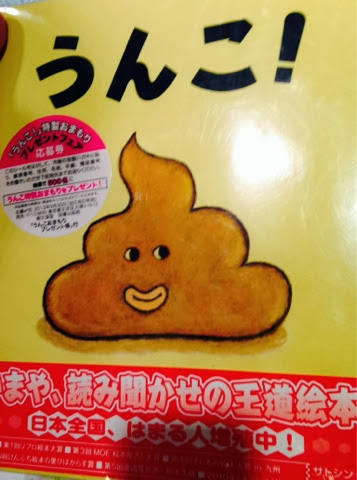
I found these in the children's fiction section of Tsutaya in Shibuya, shelved somewhere between Winnie the Pooh and the Moomins. It's a small section, just four or five shelves, and so each book is presumably chosen with some care. This begs the question: are these normal children's books, or am I ultra prudish?

Literally, the title of this book in English is 'Shit!' Or so says Google translate.

'Little Black Sambo'


Wednesday, 6 November 2013

The mountain who wanted to be a skyscraper

Maybe it's just me, but when I think 'mountain' I think 'rural', 'solitude', etc. Not so on Takaosan.

Men will wave sticks of soy-coated mochi at you until, will weak as tired knees on the 45 degree (paved, concrete) ascent, you finish your 'kudasai'. Agility somewhat impaired by the glutinous result of your weak will, you wonder about a break. 'Of course', Takaosan nods: 'would you prefer some shopping, a little sake, or a trip to the monkey park?' (Yes, Takaosan boasts, alongside its wild monkeys, a mini enclosure full of them. It also advertises, in capital letters, a GRASS PARK, but somehow that seemed less exciting...).

It's as if 50 years ago Takaosan grew afraid of being called old-fashioned by its new neighbour, Mr Tokyo, and decided to catch up. 'Look! I'm just like you, I have shops and restaurants and booze! I'm not like all those other mountains, those sad old things with their trees and rocks. I'm just like a street, but vertical!  Sugoi desu ne?! Rooms and shops extending, scraping the sky - mark my words it'll catch on some day... '

Tokyo from Takaosan

Caterium


Now that the time's come for me to revise for today's big grammar test, I have remembered my promise, to some of you, to elaborate on the cat cafe.

You might assume that a cat cafe is a cafe more or less like any other, the sort of place with tables and chairs and drinks etc, just with cats dotted around. You might imagine, as I did, that a cat cafe is really a cafe for humans; a place for people who can't keep a pet to play with one for an hour or two. Really though, a cat cafe is just what it says it is: a cafe for cats. It is a place where cats eat and drink and chat and play, and humans watch them. It is a space filled with toys and scratch posts and cushioned baskets, and nothing so dull as an actual chair. People sit and lie on beanbags while cats crouch high on bookshelves, watching humans read magazines about them, and wondering whether to jump down and countenance a little affection. 'Certainly not from that man over there,' they seem to decide, 'that smiling salaryman brandishing a length of string. Too desperate. But that one over there, the one who seems actually to have forgotten about me... Has she seriously come  to my cafe to talk to her boyfriend? That will not do.'

When the proprietors decide that the cats are not looking sufficiently kawaiiiiiii, it's time for the hats. The cats for their part see this as no indignity- for them it seems quite proper their nobility should be marked by these woolly crowns (which incidentally keep one's ears very toasty). They recline and watch with regal disdain the cooing humans below.


Friday, 25 October 2013

Calling all genteel gangsters

Imagine you're a Yakuza boss, and things aren't going so well lately. Yakuza comrades (so-called kyodai and shatei: big brothers and little brothers) are dropping out of your family like hefty, tattoed flies. The prosthetic finger tips you gave them haven't mollified them. Perhaps you were a little hasty to make them say sayonara to their little finger tips, but that's the way it's always been. 'Yubitsume', or punishment by finger-chopping, is a centuries-old safeguard against treachery. A man grips the sword with his thumb on one side of the hilt and fingers on the other: as you chop off his fingertips his grip on the sword gets progressively weaker and he becomes more dependent for his safety on his group of allies.

But the group is declining: members numbered around 67,000 in 2011 but dwindled to 62,000 in 2012. So what can you do to persuade your fellow gangsters that the Yakuza is still worth being part of; that the police crackdown on businesses that associate with you isn't going to affect your prospects? Then it hits you; how about a magazine written by the Yakuza, for the Yakuza? Perfect!

Earlier this year the Yamaguchi-gumi, one of the Yakuza's most powerful branches, published the Yamaguchi-gumi Shinpo, an intra-Yakuza magazine. Its pages feature interviews with Yakuza bosses and inspirational words from Kenichi Shinoda – the head of this Kobe-dwelling syndicate – and perhaps you'd expect these things. More interestingly, its pages brim with fishing diaries of senior gangsters, and haiku. I guess that sometimes when you're not busy doing all the things that a good gangster should – blackmailing, intimidating, hustling, gambling – you miss a good haiku. Sometimes you wish that you had more time to pursue a pastime as peaceful as angling, and devour descriptions of your seniors' catches.

So, genteel gangster, Yamaguchi-gumi Shinpo is for you. Stick with the Yakuza: we still represent that strong, traditional Japan that you miss. But make sure still to be on your best behaviour; it's hard to write poetry with too many fingers missing.
Thursday, 24 October 2013

How not to look like a cannibal in Japan

Question: Did you have a nice dinner? Seems fairly innocuous, but there are two dangerously similar answers...


Option one:

Hai, oishi katta desu

はい,おいしかったです

Yes, it was delicious


Option two:

Hai, oishii kata desu

はい,おいしいかたです

Yes, it's a delicious person.


You don't want accidentally to look like this guy:

http://en.wikipedia.org/wiki/Issei_Sagawa


Sunday, 13 October 2013

Green


Today, wandering through Higashi Matsubara, I realised that one colour can sometimes be elusive in this concrete jungle. 

A word for 'green' did not originally exist in Japanese, I've been told, green being subsumed under blue for centuries with the result that apples and traffic lights are still referred to today as 'ao' - blue.   


Friday, 11 October 2013

The Language Instinct Fail

Starting out as a two year old Japanese person is more difficult than I imagined, as The Very Hungry Caterpillar is proving quite heavy reading for this gaijin.

Two weeks of language school later and I can say with total confidence that:

つくえのうえにみかんがあります, phonetically 'Tsukue no ue ni mikan ga arimasu' - There is an orange on the desk.

[When I first typed this into Google translate, from Japanese to English, I typed: つくえのえうにみかんがあります - mistyping just one letter and unwittingly changing the phrase to 'Tsukue no eu ni mikan ga arimasu'. The translation read: 'There is a mandarin orange sea urchin picture desk'. Now I know two very useful phrases.]